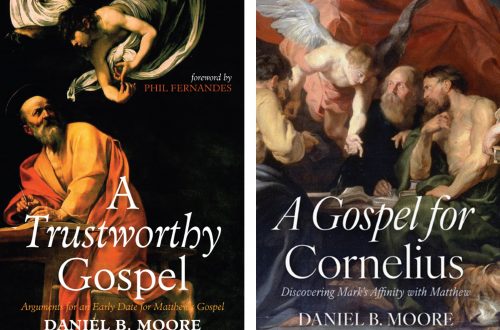
I am pleased to share that my upcoming book, A Gospel for Cornelius: Discovering Mark’s Affinity with Matthew (2026), has nearly completed the copy editing phase at the publisher (Wipf & Stock) and should be available in print by September, with digital versions available sometime later. Whereas my prior book, A Trustworthy Gospel: Arguments for an Early Date for Matthew’s Gospel (2024), made the case that Matthew was published within a decade of the resurrection and coincident with the events of Acts 10–11, A Gospel for Cornelius proposes that Mark was published coincident with the events of Acts 12 for the benefit of Cornelius and friends in Caesarea Maritima after their conversion following Peter’s visit.1 Again, this paradigm operates under the premise that the apostles would not have significantly delayed in publishing Gospel accounts as the need arose, as argued in A Trustworthy Gospel. It also continues to leverage the testimony of the Church Fathers from the perspective that when they spoke of “Rome,” with respect to the publication of the Gospels, they were referring to Rome, the empire, as Peter and Paul began preaching to those who were not Jews.
Irenaeus reported that:
Matthew also issued a written Gospel among the Hebrews in their own dialect,2 while Peter and Paul were preaching at Rome,3 and laying the foundations of the Church. After their departure, Mark, the disciple and interpreter of Peter, did also hand down to us in writing what had been preached by Peter. [Irenaeus, Against Heresies 3.1.1]
Here is the tentative back cover:
Let us assume that Mark was published for the benefit of Cornelius and other non-Jewish believers in the Roman enclave of Caesarea Maritima, shortly after Matthew was published. Under this premise, what insights might be gained by considering Mark’s affinity with Matthew, when combined with an awareness of Mark’s literary tendencies? For example, supposed difficulties and obscure expansions in Mark, such as the odd quote from Malachi in Mark 1:2 and the reference to wild animals in Mark 1:13, can be recognized as subtly connecting the Gospels while also deepening narrative contexts for those within Mark’s audience who were already familiar with Matthew. Motivations behind Mark’s resequencing of the Galilean narratives can be explained. Mark’s alleged contradictions with Matthew, such as the split fig tree story in Mark 11, can be recognized as having been arranged for the benefit of Mark’s Greco-Roman audience, without suggesting a conflict with Matthew’s chronological account. Skeptical challenges to the doctrine of inerrancy based on such passages can therefore be dismissed. For students of the Synoptic Gospels, this study offers exegetical insights into Mark, while continuing to demonstrate the explanatory power and apologetic benefit of Matthean priority.
Am eager to get this volume out to everyone!
- For a comparison with David Alan Black’s paradigm, see An alternative to Black’s four stages of Gospel development. ↩︎
- See A Trustworthy Gospel and “The language of Matthew and the use of the dative of respect for contrast” for my argument that Irenaeus should be read as declaring that Matthew was originally published in Greek. ↩︎
- More on this at Irenaeus’ “at Rome” affirms an early Matthew! ↩︎
NOTE: Comments and dialog are welcome. The “Leave a Reply” field will be accessible below for 10 days after this post was published. Afterwards, please feel free to continue to comment via the contact page. (This is my attempt to manage the spam bots.)