Latest Posts:
- Luke’s resequencing of the temptations of Jesus

What novel insights might be discerned (or speculated!) by reading Luke’s Gospel under the premise that it was published in the early AD 50s, for the benefit of churches being planted in Macedonia and Achaia (Greece) during Paul’s second missionary journey? This is the publication scenario that arises if one accepts that 2 Corinthians 8:18 is referring to Luke and his Gospel. But further, what if we also presume that Luke had full knowledge of a chronologically-accurate Matthew, published within a decade of the resurrection, along with Mark, published shortly thereafter, as proposed in A Trustworthy Gospel and A Gospel for Cornelius?1
In this article we consider Luke’s resequencing of Jesus’ three temptations, whereby Luke 4:1–13 (with its temptations concerning bread, power, and preservation) is assumed to have intentionally rearranged the temptation order found in Matthew 4:1–11 (bread, preservation, power). First, we’ll look at the transitional language in Luke and affirm that Luke is not claiming to present a chronological sequence that might conflict with Matthew’s (assumed) chronological sequence. Then, we’ll survey several scholars for their proposals as to why Luke might have resequenced the three temptations. Finally, I’ll offer a novel proposition for why Luke might have made the change, under the premise of an early AD 50s publication. I do recognize that the proposition is speculative and only mildly insightful; yet, perhaps the approach will productively combine with insights to be gained elsewhere in Luke, as we continue to view such through the lens prescribed above.
TRANSITIONAL LANGUAGE
Before conducting a survey of possible reasons for why Luke might have rearranged the three temptations, it is appropriate to affirm that the transitional language in Luke, connecting the three temptations, does not assert a chronological sequence that conflicts with Matthew’s sequence. We start by recognizing that the transition into Luke’s second temptation (Luke 4:5–8), where the devil offers to give Jesus power over the kingdoms of the world, begins with a simple conjunction (kai), while the third temptation (Luke 4:9–12), where the devil invites Jesus to test God’s commitment to Jesus’ preservation, is introduced with a simple contrastive conjunction (de). These conjunctions do not necessarily assert a specific sequence, and therefore do not present a conflict with Matthew’s presumed chronologically-accurate sequence.2 On the other hand, Matthew itself uses an adverb (then/tote) that does convey sequence; although the sequence may be either temporal or logical. However, Matthew also leverages another adverb (again/palin), which in combination with tote does suggest a chronological sequence: “then (tote) the devil took him to … the pinnacle of the temple … Jesus said to him, ‘Again (palin) it is written’ … again (palin) the devil took him to a very high mountain … then (tote) Jesus said to him” (Matt. 4:5–10).3
WHAT DO SCHOLARS SUGGEST, FOR WHY LUKE MIGHT HAVE REARRANGED THE TEMPTATIONS?
Of those scholars who affirm that it is Luke who has departed from Matthew’s sequence, what motivations are proposed? Marshall suggests that Luke has rearranged the sequence in order to “lay stress on the [subsequent] conclusion of the temptations in the temple.”4 Garland offers a similar assessment, noting that “In Luke’s extensive travel narrative beginning in 9:51, Jerusalem is the goal of Jesus’ ministry and [the place of] his ‘exodus’ … When he finally arrives in the city, he faces his greatest temptation and prays that God might, if possible, rescue him from his impending death.”5 Of course, despite Jesus’ appeal for deliverance, Jesus will still press ahead towards the cross. Geisler and Howe also suggest that Luke has arranged the three temptations “to express the climax he desired to emphasize”; namely, the temptation at the temple.6 Garland adds that Luke’s temptation arrangement allows for the corresponding OT citations to follow a sequence that aligns with the events recalled in Psalm 106 (106:14–15 to 106:19–20 to 106:32–33), events in which Israel had failed by succumbing to temptation.7 More broadly, Bock credits Schulz as asserting that “Luke has a theological motive for his rearrangement. For Luke, Jerusalem is the climactic locale of conflict in Jesus’ life”; hence, “Luke’s rearrangement places emphasis on the Jerusalem temple.”8 Each of these speculations are insightful. Yet, within the context proposed above, whereby Luke is presumed to have been written in the early AD 50s for the benefit of the churches being planted in Macedonia and Achaia, perhaps the climactic emphasis on the temple temptation is driven by something beyond the mere anticipation of events in Jerusalem.
A SPECULATIVE PROPOSAL
According to Luke’s travelogue of Paul’s missionary activity, Paul was in Troas when he had a vision of a man from Macedonia who implored Paul to “Come over to Macedonia and help us” (Acts 16:6–10), to bring the gospel into a region where Greek and Roman culture flourished. Significantly, it was in Troas where Luke joined the team, per the “we” passages in Acts. Was it a mere coincidence that Luke joined the mission at this point? As readers, we are aware that Luke would ultimately write a Gospel that appears to target this more sophisticated audience, that employs a more “polished style than the other Gospel writers.”9 Consequently, rather than being a chance encounter, I suggest that Paul’s vision and the appearance of the one who was destined to write a Gospel for the benefit of those in the region were not unrelated. Further, if an early AD 50s date for the publication of Luke’s Gospel is to be accepted, along with Luke’s claim to have “followed all things closely for some time past” (Luke 1:3), then this suggests that Luke had already largely completed his research, such as interviewing Mary, prior to joining Paul in Troas. Per this scenario, it appears that a divine appointment brought Luke to Troas, that he might share in the vision’s mandate to take the gospel/Gospel to the region (Acts 16:10).
Luke initially traveled with Paul, Silas, and Timothy only so far as Philippi, a city that Luke described as a leading city of Macedonia and a Roman colony (Acts 16:11–24; 17:1). Notably, Philippi was a city that had prospered greatly under Roman rule, after being the site of a great battle in 42 BC when “the forces of Octavian and Anthony defeated the conspirators who had murdered Caesar.”10 It was a city boasting a “rectangular forum surrounded on three sides by the columns of a stoa” (a covered walkway), beside which “stood two Corinthian temples.”11 And, “in a terrace above the city stood a sanctuary of five shrines for the worship of the Egyptian gods.”12 Indeed, across the cities surrounding the Aegean Sea, imposing temples to a plethora of gods could be found. And in many cities, Jewish synagogues could also be found. Accordingly, Paul and his traveling companions would pass many a temple and visit many a synagogue as they journeyed through Macedonia and Achaia on the second missionary journey. In fact, Luke’s travel narrative appears quite attentive to these fixtures of society.
While scholars generally speculate that Luke shifted the Jerusalem temple temptation last in order to establish a connection with the events that would occur later in Jerusalem, I suggest that Luke is instead emphasizing the temple temptation with the intent of connecting this event with the world of Luke’s audience. For the Jewish portion of Luke’s Christian audience, we may speculate that they would connect the temptation at the temple with both Jesus’ Jewishness and his exalted position over the temple, given his ascension to the pinnacle. More significant though, for the Greco-Roman portion of Luke’s Christian audience, we may speculate that they would recognize the significance of Jesus’ ascension to the temple’s pinnacle as symbolic of his authority over all temples. Nicholas Perrin highlights the significance of pagan temples: “in the ancient world, the temple, typically perceived as the microcosm and center of the universe, defined reality as a whole.”13 For those already recognizing Jesus’ elevated position as Son of God and Savior, his confident stance above the Jewish temple defied not only the devil, but false gods worshiped elsewhere.
Furthermore, in this final temptation Jesus allows the devil’s mocking recognition of Jesus’ title as “Son of God” to stand unchallenged (Luke 4:9–12)—Jesus only responds to the sinful enticement to put the Lord to the test by stepping off the edge (4:12). Yet, more so than in Matthew’s account of events leading up to the temptations, Luke’s Gospel has already placed an emphasis on pronouncements that Jesus was indeed the Son of God, savior of Israel, and a light to the nations—as announced by the angel to Mary (Luke 1:32–35), as declared by angels to shepherds (2:11), as recognized by Simeon and Anna in the temple (2:30–31, 38), as declared by the voice from heaven at his baptism (3:22), and as asserted in Luke’s genealogy (3:38). Thus, given Luke’s precursor attestations and the defacto (positional placement) emphasis placed on Luke’s third temptation, even the devil’s voice is effectively added to the choir of those recognizing Jesus as God’s Son.
SUMMARY
In sum, I suggest that Luke has resequenced the temptations relative to Matthew’s account—by elevating the temple temptation by placing it third—not for the sake of drawing a connection with subsequent events at the temple in Jerusalem, but for the sake of connecting with the world of Luke’s audience. Believing Jews would identify with Jesus’s Jewishness and exalted position over the temple, while believing Greco-Romans would recognize his authority over local temples and the false gods worshiped therein. Again, in Acts, we can observe Luke’s attentiveness to both synagogues and temples as significant fixtures of society, as Paul ministers in Macedonia and Achaia. In addition, the temptation arrangement also brings further attention to Luke’s emphasis in identifying Jesus as the Son of God.
Still, regardless of whether or not my insights/speculations are more correct than those of the cited scholars, this assessment does offer another example demonstrating that publication presuppositions do indeed impact exegesis.
- Daniel B. Moore, A Trustworthy Gospel: Arguments for an Early Date for Matthew’s Gospel (Eugene, OR: Wipf and Stock, 2024); Idem, A Gospel for Cornelius: Discovering Mark’s Affinity with Matthew (Eugene, OR: Wipf and Stock, 2026). ↩︎
- Norman L. Geisler and Thomas A. Howe, The Big Book of Bible Difficulties (Grand Rapids, MI: Baker, 1992), 328–29. ↩︎
- Bock states that “The clearest temporal adverbs occur only in Matthew.” Darrell L. Bock, Luke: 1:1–9:50, Baker Exegetical Commentary on the New Testament (Grand Rapids, MI: Baker Academic, 1994), 366. ↩︎
- I. Howard Marshall, The Gospel of Luke: A Commentary on the Greek Text, New International Greek Testament Commentary (Exeter, UK: Paternoster, 1978), 167. ↩︎
- David E. Garland, Luke, Exegetical Commentary on the New Testament (Grand Rapids, MI: Zondervan, 2011), 178. ↩︎
- Geisler and Howe, Big Book, 329. ↩︎
- Garland, Luke, 178. Garland includes a reference to Hannah Swanston, “The Lukan Temptation Narrative,” JTS 17 (1966). ↩︎
- Siegfried Shultz, Q: Die Spruchquelle der Evangelisten (Zurich: Theologischer Verlag, 1972), 177, 177n2, as cited in Bock, Luke: 1:1–9:50, 366. ↩︎
- A productive survey of Luke’s style is found in Mikeal C. Parsons, Martin Culy, and Joshua J. Stigall, Luke, Baylor Handbook on the Greek New Testament (Waco, TX: Baylor University Press, 2003), xix–xxii. “Luke writes on a much more sophisticated Greek level than Mark.” Craig S. Keener, Christobiography: Memory, History, and the Reliability of the Gospels (Grand Rapids, MI: Eerdmans, 2019), 31. ↩︎
- M. R. Palairet, Macedonia: Vol. 1, From Ancient Times to the Ottoman Invasions: A Voyage Through History (Newcastle upon Tyne, England: Cambridge Scholars Publishing, 2015), 106, 109–10. ↩︎
- Ibid., 109. ↩︎
- Ibid. ↩︎
- Nicholas Perrin, Luke: An Introduction and Commentary, Tyndale New Testament Commentaries (Westmont, IL: InterVarsity, 2022), 1–2. ↩︎
NOTE: Comments and dialog are welcome. The “Leave a Reply” field will be accessible below for 10 days after this post was published. Afterwards, please feel free to continue to comment via the contact page. (This is my attempt to manage the spam bots.)
- Paper to be presented at 2026 Tyndale Conference
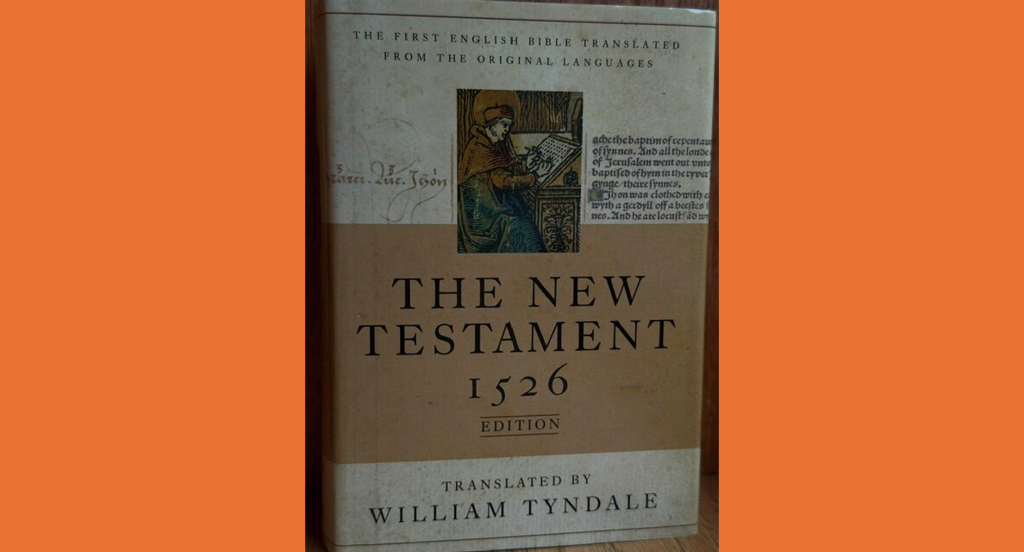
For those who may be interested, at this year’s 2026 Tyndale Conference I will be presenting (via Zoom) a version of my paper “Inerrancy, Patterns of Behavior, and The Implications of an Early Gospel Publication.” The conference is being hosted by the Commonwealth Community Baptist Church in the Bronx, on November 14. The theme of this year’s conference is, “Thy Word Is True from the Beginning.”
The conference will be live streamed and presentations will be posted on CCBC’s YouTube channel. Please refer to the event website for updates and streaming information. https://commonwealthbronx.org/uncategorized/tyndale-conference-2026/
The tentative schedule:
Saturday, November 14, 2026
9AM – Doors open for refreshments
10AM – Andrew T. Knight, PhD – The Biblical Method of the Anabaptists During the 16th Century in Western Europe (Remote on Zoom)
11AM – Marquise Burwell, MBS – Diligently Seeking God Requires Faith in His Preserved Words (In Person)
12Noon – Daniel B. Moore, ThM – Thy Word is True: Inerrancy, Patterns of Behavior, and The Implications of an Early Gospel Publication (Remote on Zoom)
1PM – Lunch
2PM – Joel R. Grassi, ThD – Matthew’s Genealogy in Tyndale’s 1526 New Testament – Theological and Practical Observations (In Person)
Conclusion of Conference
- Why did I write these books?
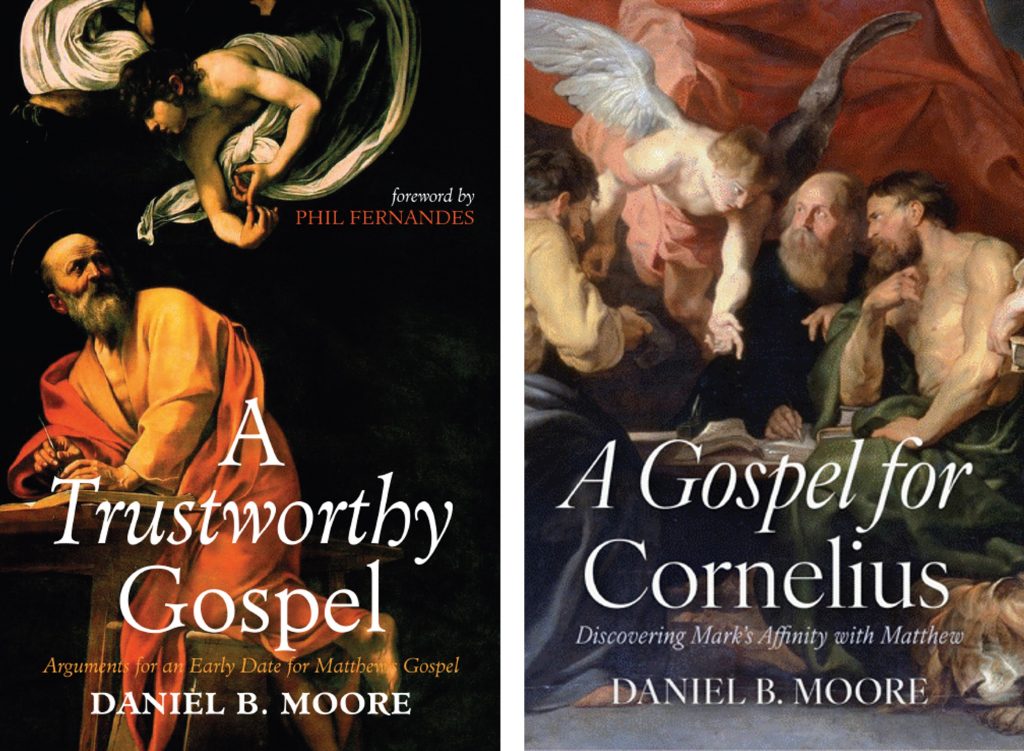
In “A Trustworthy Gospel,” I confront Gospel integrity challenges that arise when it is accepted that the earliest Gospels were not published until several decades after the resurrection. Yes, divine inspiration can ensure accuracy, but the New Testament authors also asked readers to trust their eyewitness testimony. In accepting these delays, Christian apologists have unfortunately latched onto what I call a novel doctrine of “perfect apostolic memory” in order to defend the integrity of the Gospels as accurate eyewitness testimony. I suggest that this neither reduces the skepticism of antagonists, nor engenders more confidence in Gospel reliability amongst Christians. Instead, I argue that belief in an early Matthew, published within a decade of the resurrection, is reasonable, defensible, and preferable over alternative speculations.
In “A Gospel for Cornelius,” I counter Gospel integrity challenges that arise due to content and sequential discrepancies between the Gospels of Matthew and Mark. Some Gospel critics claim that these differences demonstrate that the doctrine of inerrancy needs to be abandoned or reimagined to allow for errors or creative adaptations by the authors. Rather, I contend that many of these differences can be explained on the premise that an early Mark (AD 40–45) was published shortly after a chronologically accurate Matthew, if one is sensitive to Mark’s literary tendencies.
- Does Luke 1:2 allude to the Gospels of Matthew and Mark?

For those of us who contend that Luke’s Gospel leveraged Matthew and Mark, it is helpful to carefully work through Luke’s prologue, where Luke speaks of the narratives of Jesus that were available prior to his own account. Within the text of Luke 1:2 there are interpretive options that potentially align with a Matthew-Mark-Luke publication sequence, options that may not be obvious if one simply defers to modern English translations and commentaries.
1 Inasmuch as many have undertaken to compile a narrative of the things that have been accomplished among us, 2 just as those who from the beginning were eyewitnesses and ministers of the word have delivered them to us, 3 it seemed good to me also, having followed all things closely for some time past, to write an orderly account for you, most excellent Theophilus, 4 that you may have certainty concerning the things you have been taught. (Luke 1:1–4 ESV)
The following article considers two issues: (1) What comparison is being made between Luke 1:1 and 1:2; and (2) To whom does the reference to “eyewitnesses and ministers of the word” refer?
WHAT COMPARISON IS BEING MADE BETWEEN LUKE 1:1 AND 1:2?
The conjunction that begins Luke 1:2, kathōs (commonly translated, “just as”), indicates that some kind of comparison or contrast is being recognized between (1) recent compilations of the Jesus narrative by the “many” (1:1) and (2) whatever had previously been “delivered” by the “eyewitness and ministers of the word” (1:2). Culy, Parsons, and Stigall explain that “the subordinating conjunction, kathōs, draws an analogy between the work of those who attempted to compose an account and those who had earlier passed on the tradition.”1 Unfortunately, Luke does not clarify the nature of that which was previously delivered by the “eyewitnesses and ministers of the word.” Therefore, stepping into this lack of clarity, Marshall asserts that, “Luke distinguishes between the writers of the Gospels and the apostolic eyewitnesses on whose testimony they were dependent.”2 Similarly, Bock confidently declares that “a clear allusion” is being made “to the original oral level of the tradition” as delivered by the eyewitnesses and the subsequent narrative accounts.3
Yet, these views presuppose that the earlier “eyewitnesses and ministers of the word” themselves did not deliver Gospels, a perspective that I contend is not necessitated by the passage. To start with, it is important to observe that variants of the word used here for “delivered” (root: paradidōmi) can indeed refer to the delivery of authoritative written materials. Luke employs variations of this word to describe how Paul and his team “delivered (root: epididōmi) the letter” from the Jerusalem council to Antioch (Acts 15:30) and again later, to describe how soldiers from Jerusalem “delivered (root: anadidōmi) the letter to the governor” in Caesarea concerning Paul (Acts 23:33). In addition, contemporary writers such as Philo,4 Josephus,5 and Plutarch6 employed similar verbs concerning the delivery of documents. Thus, although Luke 1:2 does not definitively assert that written documents are in view or not, I suggest that we should be open to the possibility that Luke could have in view here materials such as Gospels, as being previously delivered by the eyewitnesses and ministers of the word.
TO WHOM DOES THE REFERENCE TO “EYEWITNESSES AND MINISTERS OF THE WORD” REFER?
In the Greek text of Luke 1:2, the “just as (kathōs)” is immediately followed by “have delivered to us (paredosan hēmin).” These words have been adequately addressed above. However, there is also debate over the proper translation and interpretation of the balance of the verse, given its ambiguous structure. Karl Kuhn allows for “at least three plausible translations:
- ‘from the beginning those who were eyewitnesses and those who were ministers of the word’ (viewing ‘eyewitnesses” and ‘ministers of the word’ as two separate groups.) …
- ‘the eyewitnesses from the beginning (or ‘original eyewitnesses’) who became ministers of the word.’ …
- ‘those who from the beginning were (both) eyewitnesses and ministers of the word.’”7
The first option, though a minority position per Kuhn, understands Luke as identifying two distinct groups who had each delivered something, while the second and third options understand Luke as referring to a single group who could be acknowledged as both eyewitnesses and ministers of the word.
Given my premise that Matthew and Mark were both leveraged by Luke, this first option is intriguing. Could Luke 1:2 be acknowledging Matthew (and his Gospel), as one who had been an eyewitness (autoptai) from the beginning (ref. Acts 1:21–22), and Mark (and his Gospel), as one who was a minister (hypēretai) of the word? Significantly, Luke specifically names John Mark as a hypēretēn (Acts 13:5), using the singular form of the noun. Further, note that while most English translations supplement the Greek text to identify Mark as an assistant to his traveling companions, “and they had John to assist them” (ESV), the text merely states that they had Mark as hypēretēn. My point being that Luke distinguishes Mark as having a specific role and title in Acts 13:5, perhaps akin to other hypēretēs who had literary skills, such as the hypēretēs handling the Isaiah scroll in Nazareth (Luke 4:20) and the various hypēretēs mentioned in Plutarch’ writings.8 Granted, hypēretēs was a term broadly used in biblical and contemporary texts for officials and attendants (BDAG), whether or not a literary role was involved; however, on my premise that Mark had already published his Gospel prior to the events of Acts 13:5 and the publication of Luke, I see particular significance in Luke 1:2’s reference to “ministers of the word.”
But what about Kuhn’s other translation options, which are more popular among biblical scholars? A significant problem with both options two and three is that there is nothing in the sentence structure itself that definitively claims that the same people are in view, when eyewitnesses and ministers are being referenced.9 Many scholars leverage the plural article (the/oi) that stands at the beginning of the phrase to make the assertion that the “eyewitnesses (autoptai) and (kai) ministers (hypēretai)” should be understood as a singular collective group. For example, Bovon claims that, “The ‘eyewitnesses’ are the same as the ‘servants of the word’; since only one article (oi) appears in the text, it must refer to the same persons exercising two functions.”10 This approach appears to leverage the Granville Sharp rule, whereby it was found that singular nouns joined by kai refer to the same person, when following a singular article.11 However, there are several conditions that limit the applicability of the rule; most significantly, that it does not apply to plural nouns! If plural nouns are involved, then some level of connection exists that may rise to the level of a common identity, but a common identity is not necessitated by the construct itself.12 Furthermore, Wallace contends that in this particular passage, the article (oi) actually modifies (or substantizes) the following prepositional phrase (“from the beginning”/ap’ archēs), rather than pairing with the subsequent nouns (“eyewitnesses and ministers”), hence the article has no bearing on whether the nouns should be understood as referring to the same group or not.13 Culy, et al, make a similar observation, though pairing the article with a latter participle in the sentence (they were/genomenoi), rather than the prepositional phrase claimed by Wallace.14
The bottom-line is that any claim that Luke’s “eyewitnesses” and “ministers” must refer to a singular group, rather than to two groups (that may overlap), must be argued on some basis other than the immediate text at hand. Some scholars do in-fact make this argument based on various other passages where apostles are identified as witnesses and servants, such as Paul’s self-identification as an appointed “servant and witness (martys)” in Acts 26:16.15 Nevertheless, I suggest that Paul’s ability to wear both labels does not necessitate that the meaning of Luke 1:2 must also be restricted to a single group wearing both labels—especially since Paul himself would not fit within this Luke 1:2 group as “one who from the beginning” was an eyewitness!
SUMMARY
In summary, the text of Luke 1:2 leaves open the possibility that Luke may indeed have had the prior Gospels of Matthew and Mark in view, alongside other material both written and oral, produced by other eyewitnesses and ministers of the word. This perspective becomes particularly appealing if we presuppose the publication sequence and timing postulated in A Trustworthy Gospel and A Gospel for Cornelius.16
- Mikeal C. Parsons, Martin Culy, and Joshua J. Stigall, Luke, Baylor Handbook on the Greek New Testament (Waco, TX: Baylor University Press, 2003), 2–3. ↩︎
- I. Howard Marshall, The Gospel of Luke: A Commentary on the Greek Text, New International Greek Testament Commentary (Exeter, UK: Paternoster, 1978), 41–42. ↩︎
- Darrell L. Bock, Luke: 1:1–9:50, Baker Exegetical Commentary on the New Testament (Grand Rapids, MI: Baker Academic, 1994), 58–59. ↩︎
- For example, “when they arrived they delivered (root: anadidōmi) the letter.” Philo, Embassy 254; Philo, Philo: Volumes I-X, vol. 10, trans. F. H. Colson, The Loeb Classical Library (Cambridge, MA: Harvard University Press, 1962). ↩︎
- For example, “and [everyone] gives (root: didōmi) them letters to be carried to their familiar friends.” Josephus, Jewish War 7.353; Flavius Josephus, The Works of Josephus: Complete and Unabridged, trans. William Whiston (Peabody, MA: Hendrickson, 1987). Similarly, Josephus, Antiquities 7.136; 11.117, 122; etc. ↩︎
- For example, “Alexander handed (root: epididōmi) him the letter.” Plutarch, Alexander 19.3; Plutarch, Lives, Volume VIII: Sertorius and Eumenes. Phocion and Cato the Younger, trans. Bernadotte Perrin, Loeb Classical Library (Cambridge, MA: Harvard University Pres, 1919). ↩︎
- Karl A. Kuhn, “Beginning the Witness: The Αυτοπται Και Υπηρεται of Luke’s Infancy Narrative,” New Testament Studies (Cambridge, UK) 49, no. 2 (2003): 237–38. ↩︎
- A few other clear references to hypēretēs, as a literate servant or clerk, include Plutarch, Cato. Mi. 28.1; Art. 29.4; Caesar 65.1. See also B. T. Holmes, “Luke’s Description of John Mark,” Journal of Biblical Literature (Philadelphia, Pa) 54, no. 2 (1935): 63–72. ↩︎
- Contra Marshall. I. Howard Marshall, The Gospel of Luke: A Commentary on the Greek Text, New International Greek Testament Commentary (Exeter, UK: Paternoster, 1978), 42. ↩︎
- François Bovon, Luke 1: A Commentary on the Gospel of Luke 1:1-9:50, trans. Christine M. Thomas, Hermeneia (Minneapolis, MN: Fortress, 2002), 21. Likewise, Robert H. Stein, “An Early Recension of the Gospel Traditions?,” Journal of the Evangelical Theological Society 30, no. 2 (June 1987): 167–83, 174; Nicholas Perrin, Luke: An Introduction and Commentary, Tyndale New Testament Commentaries (Westmont, IL: InterVarsity, 2022); Joseph A. Fitzmyer, The Gospel According to Luke: Introduction, Translation, and Notes, Anchor (Garden City, NY: Doubleday, 1981), 294. ↩︎
- Daniel B. Wallace, Greek Grammar Beyond the Basics: An Exegetical Syntax of the New Testament (Grand Rapids, MI: Zondervan, 1996), 270–72. ↩︎
- Ibid., 270. ↩︎
- Daniel B. Wallace, Granville Sharp’s Canon and Its Kin: Semantics and Significance (New York, NY: Peter Lang, 2009), 142n14. ↩︎
- Mikeal C. Parsons, Martin Culy, and Joshua J. Stigall, Luke, Baylor Handbook on the Greek New Testament (Waco, TX: Baylor University Press, 2003), 3. ↩︎
- For example, David E. Garland, Luke, Exegetical Commentary on the New Testament (Grand Rapids, MI: Zondervan, 2011), 53. Although, Garland recognizes the terminology as “slippery.” Ibid., 53n16. ↩︎
- Daniel B. Moore, A Trustworthy Gospel: Arguments for an Early Date for Matthew’s Gospel (Eugene, OR: Wipf and Stock, 2024); Daniel B. Moore, A Gospel for Cornelius: Discovering Mark’s Affinity with Matthew (Eugene, OR: Wipf and Stock, 2026). ↩︎
NOTE: Comments and dialog are welcome. The “Leave a Reply” field will be accessible below for 10 days after this post was published. Afterwards, please feel free to continue to comment via the contact page. (This is my attempt to manage the spam bots.)
- My thanks to those who coordinated and hosted the ISCA conference in Wichita last weekend

My thanks to those who coordinated and hosted the ISCA conference in Wichita last weekend. Celebration Baptist Church had a nice facility for the gathering, and we enjoyed meeting several of their people. It was also nice to connect and catch up with those from ISCA and attend several paper presentations. The last conference had been in Carlsbad, CA, and we had followed up with an outing to Joshua Tree National Park. This time we followed the conference with a flight up to South Dakota, and visits to Mt. Rushmore, Wind Cave NP, Custer State Park, Badlands NP, etc., before returning to Washington.
At the conference, I had a table for promoting my books and had many opportunities for talking with folks about early dates for the Gospels of Matthew and Mark. My paper presentation also went well (or at least I thought so!).
Here are a couple pics of SD: