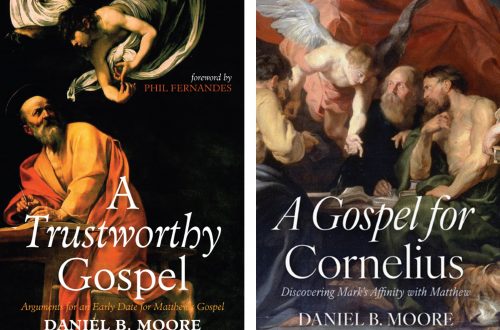
If the arguments for the early publication of Matthew in A Trustworthy Gospel are accepted, then what are the implications for the next Gospel to be published? Matthew has a characteristically Jewish orientation, presenting Jesus as the long-expected Messianic king, who came to save his people from their sins. Mark and Luke both echo the “repent and believe” message of salvation, while orienting such towards a Greco-Roman audience.1 But which of these Gospels followed Matthew? In my upcoming book (am keeping the title under wraps for a bit), I explore exegetical insights and harmonization benefits under the premise that Mark was published shortly after Matthew.
In this article I want to touch on part of the rationale behind the premise that Mark was published shortly after Matthew.
A Common Motivation
If it is accepted that the apostles in Jerusalem were not hesitant to produce a written Gospel for the benefit of early Jewish believers, including those who had been scattered due to persecution (Acts 8:1), then should we not also envision the apostles as recognizing the value in producing a Gospel for the benefit of the earliest Greco-Roman believers? The conversion of the Greco-Romans in Caesarea Maritima (Acts 10–11) marks a key milestone in the accomplishment of the Great Commission, which required that the apostles “make disciples of all nations,” both “baptizing them” and “teaching them to observe all” that the Lord had commanded (Matt 28:19–20). Accordingly, just as a Gospel was required for Jewish believers, in order that they might be taught key elements of what Jesus had commanded, so also was there a pressing need to produce a Gospel for the Greco-Romans.
The Testimony of Irenaeus and Clement of Alexandria
If it is accepted (1) that apparent contradictions in the testimonies of Irenaeus and other church fathers concerning the origins of the Gospels can be reconciled by treating references to Rome as referring to the empire, rather than to the Imperial Capital,2 and (2) that Irenaeus was referring to Peter and Paul’s physical departure (exodon) into other lands rather than euphemistically referring to their deaths,3 then this suggests an early publication of Mark, roughly correlating with Acts 12.
Irenaeus reports that
Matthew also issued a written Gospel among the Hebrews … while Peter and Paul were preaching in Rome, the empire, and laying the foundations of the Church. After their departure to other lands, Mark, the disciple and interpreter of Peter, did also hand down to us in writing what had been preached by Peter. Luke also, the companion of Paul …. Afterwards, John … did himself publish a Gospel during his residence at Ephesus in Asia.4 [Italics are my additions to the classic translation by Roberts.]
With regard to Clement, my interest is limited to what Clement specifically says about the circumstances of Mark’s publication. (I will defer, until another day, engaging with Clement’s claim concerning the publication sequence of the Gospels, as recorded by Eusebius, Hist. eccl. 6.14.5–7, which is commonly leveraged by advocates of the Two Gospel Hypothesis.)
but that the Gospel according to Mark came into being in this manner: When Peter had publicly preached the word at Rome, the empire, and by the Spirit had proclaimed the Gospel, that those present, who were many, exhorted Mark, as one who had followed him for a long time and remembered what had been spoken, to make a record of what was said; and that he did this, and distributed the Gospel among those that asked him. And that when the matter came to Peter’s knowledge he neither strongly forbade it nor urged it forward.5
To connect the dots, my supposition is that John Mark was one “of the brothers,” briefly mentioned in Acts 10, who had been accompanying Peter on his preaching circuit and who then traveled with Peter from Joppa to Caesarea Maritima (Acts 10:23). This, even though John Mark is not formally introduced until Acts 12:12. Significantly, Acts 12 is a key transition passage, as James is killed, Peter is imprisoned and then miraculously released, John Mark is introduced, and then as Barnabas, Saul, and John Mark depart for Antioch. Consistent with the testimonies of Irenaeus and Clement, I therefore align the publication of Mark’s Gospel with the events in Acts 12, and with Mark leveraging the recently published Matthew.
A New Book on Mark’s Gospel!
Am pleased to share that I received today the formal offer of publication from Wipf and Stock for a book on Mark’s Gospel, not merely exploring the publication proposition above but, more significantly, exploring the exegetical insights and harmonization benefits that emerge out of this framework. I hope to have copies in-hand for November’s ETS meeting in Denver!
- In Latin loan words do not demonstrate a Greco-Roman audience for Mark, it is argued that Latin loan words do not necessitate a specifically Italian provenance for Mark, as some scholars assert. ↩︎
- See Irenaeus’ “at Rome” affirms an early Matthew! for a summary. ↩︎
- This has long been debated. For example, compare Lake’s versus McGiffert’s translation of Irenaeus in Eusebius, Hist. eccl. 5.8.2, along with Robert’s translation of Ireneaus, Haer. 3.1.1. This issue is addressed in Daniel B. Moore, A Trustworthy Gospel: Arguments for an Early Date for Matthew’s Gospel (Eugene, OR: Wipf and Stock, 2024), 32–34. ↩︎
- This is my adjustment to Roberts’ translation of Irenaeus as given in A Trustworthy Gospel. Irenaeus, Against Heresies 3.1.1; Irenaeus, “Irenæus against Heresies,” in The Apostolic Fathers with Justin Martyr and Irenaeus, vol. 1, ed. Alexander Roberts, James Donaldson, and A. Cleveland Coxe, trans. Alexander Roberts and James Donaldson, Ante-Nicene Fathers (Buffalo, NY: Christian Literature, 1885), 414; Moore, A Trustworthy Gospel, 34. The ellipsed words concern the language in which Matthew first published, which I have ellipsed here to avoid having that discussion at this time. Refer to Moore, A Trustworthy Gospel, 30–32, 34. ↩︎
- Eusebius, Hist. eccl. 6.14.6–7; Eusebius, The Ecclesiastical History, vol. 2, trans. Kirsopp Lake, J. E. L. Oulton, and H. J. Lawlor, Loeb Classical Library (London: William Heinemann Ltd, 1932), 49. ↩︎
NOTE: Comments and dialog are welcome. The “Leave a Reply” field will be accessible below for 10 days after this post was published. Afterwards, please feel free to continue to comment via the contact page. (This is my attempt to manage the spam bots.)