In A Trustworthy Gospel: Arguments for an Early Date for Matthew’s Gospel, I argued that Matthew was published in Greek within roughly a decade of the resurrection for the benefit of Jewish believers, coincident with the events in Acts 10–11, as Peter and Paul began their outreach to the Gentiles. To reconcile the testimony of Irenaeus with this assertion, I also argued that when Irenaeus discussed the origin of the Gospels in Against Heresies 3.1.1, his reference to Rome should be understood as referring to Rome, the empire. Interestingly, from this perspective, both “Irenaeus and Clement can also be understood as affirming a publication of Mark shortly thereafter, presumably at the request of the converts in Caesarea Maritima.”1
If we read Mark’s Gospel on the premise that it was published shortly after Matthew, with full awareness of the earlier Gospel, then what insights would we gain as we note how the author of Mark has leveraged Matthew’s text in his own composition? I’ve explored a few of these insights in earlier articles.
In this article, we survey several authors who have similarly concluded that Mark was written for the benefit of the Greco-Roman believers in Caesarea Maritima, the Roman provincial stronghold on the Mediterranean coast that Herod the Great developed.
Are my readers aware of any other authors who have claimed that Mark was published in Caesarea Maritima?
Thomas Birks (1852) contends that Mark was written at Caesarea, or for the local Roman converts, during the reign of Claudius around AD 48. Then, transported to the city of Rome within two or three years.2 For more on Birks, see the article from last month.3
J. H. Farmer (1915) suggests that the place of composition may be “Caesarea or Antioch, and the date not earlier than AD 50,” on the assumption that the exodon in Irenaeus refers to the departure of Peter and Paul “from Palestine or Syria [e.g. Antioch], rather than from Rome [the city].”4
Bo Reicke (1986) contends that the final redaction of Mark occurred in Caesarea, during Paul’s imprisonment circa AD 58–60. “Since the Gospel of Mark has a completely Palestinian stamp, there is reason to assume that Peter was still in the holy country when the evangelist wrote down what the apostle told or taught.”5 Reicke sees the “far-reaching harmony in the Gospels of Mark and Luke” as evidence that there were exchanges between the authors during this period.6
E. Earle Ellis (2002) argues that “one location in Palestine best fits four characteristics of Mark: the Gospel’s association with Peter, its Latinisms, its Gentile perspective and its Galilean interests. That place is Caesarea, predominantly Gentile and the Roman capital of the province of Judea.”7 Ellis also speculates that the church in Caesarea was the “other place” (Acts 12:17) to which Peter fled “given Peter’s previous mission there [Acts 10], the protective friendship of the Roman officer, Cornelius, and the large size of the city.”8 Accordingly, “the church at Caesarea would have provided the most accessible refuge after Peter’s deliverance from prison.”9 Ellis speculates that Mark traveled with Peter to Corinth (1 Cor. 1:12) and then on to Rome in AD 53–54 and, while there, “agreed to provide the churches there with a written collection of Gospel episodes. … Returning to Palestine in the mid-fifties, he composed (the first version of) his Gospel, probably AD 55–58 in Caesarea … and in the mid-sixties ‘delivered’ it to churches in Italy.”10 Ellis’ reconstruction has Peter confronting Simon Magus in Rome in c. 53–54.11
My views presently align most closely with those of Birks. While Matthew was published to support the early Jewish believers, Mark was published to support early Greco-Roman believers, at the request of those in Caesarea Maritima. Correspondingly, I suspect that it was written coincident with the events in Acts 12, prior to Mark joining Paul and Barnabas on their trip to Antioch (Acts 12:25), as the Gospel is said to reflect the teachings of Peter.
Again, if any of my readers are aware of any other scholars who have supported a Caesarean provenance, then please let me know!
I should perhaps also acknowledge awareness of various iterative or multi-redaction theories of Markan development, some of which may place the authoring of one of the early versions of Mark (e.g., an Ur-Markus or Proto-Mark) in Caesarea, such as Holdsworth’s theory, which postulates editions of Mark (i.e., Peter’s preaching) being published in Caesarea, Alexandria, and Rome.12 Am less interested in such complex speculations.
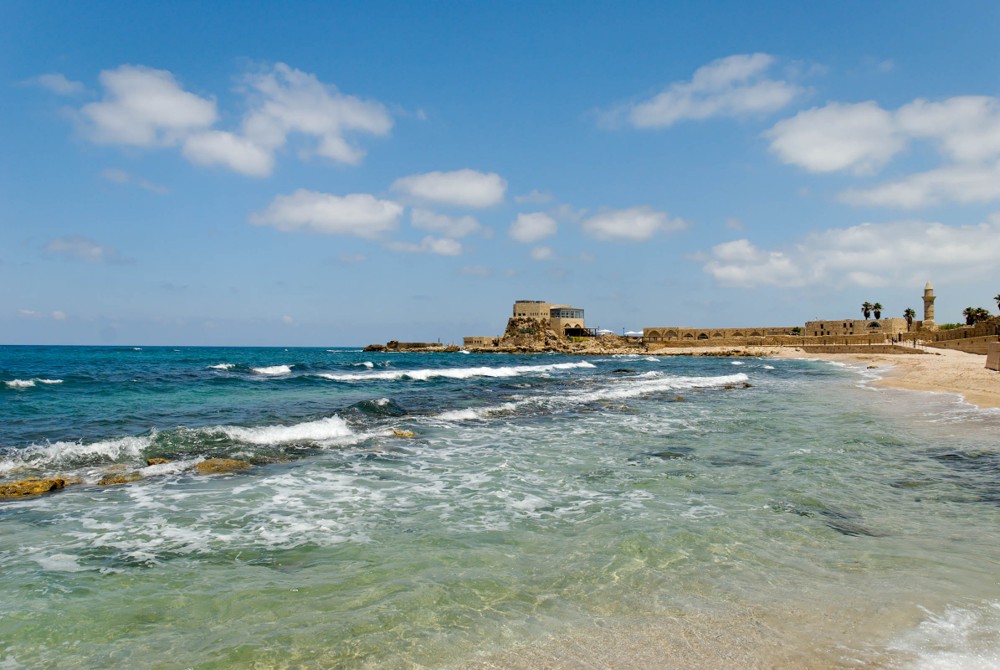
Image copyright 2019. bibleplaces.com. Used by permission.
- Daniel B. Moore, A Trustworthy Gospel: Arguments for an Early Date for Matthew’s Gospel (Wipf and Stock, 2024), 22. ↩︎
- Thomas R. Birks, Horae Evangelicae: The Internal Evidence of the Gospel History (George Bell & Sons, 1852), 232. ↩︎
- “Thomas Birks’ Horæ Evangelicæ on the dates and provenance of the Synoptic Gospels.” ↩︎
- J. H. Farmer, “Mark, The Gospel According To,” in The International Standard Bible Encyclopedia, ed. James Orr, vol. 3 (Howard-Severance, 1915), 1992. ↩︎
- Bo Reicke, The Roots of the Synoptic Gospels (Fortress, 1986), 165. Reicke dates Luke “to around AD 60” and the other Synoptics to shortly beforehand. Ibid., 180. ↩︎
- Ibid., 165–166. ↩︎
- E. Earle Ellis, The Making of the New Testament Documents (Brill, 2002), 370. ↩︎
- Ibid., 371. ↩︎
- Ibid. ↩︎
- Ibid., 375. ↩︎
- Ibid., 374. Much of Ellis’ reconstruction is in response to the varied testimonies of the church fathers. ↩︎
- William West Holdsworth, Gospel Origins: A Study in The Synoptic Problem (Charles Scribner’s Sons, 1913), 117. ↩︎
NOTE: Comments and dialog are welcome. The “Leave a Reply” field will be accessible below for 10 days after this post was published. Afterwards, please feel free to continue to comment via the contact page. (This is my attempt to manage the spam bots.)

