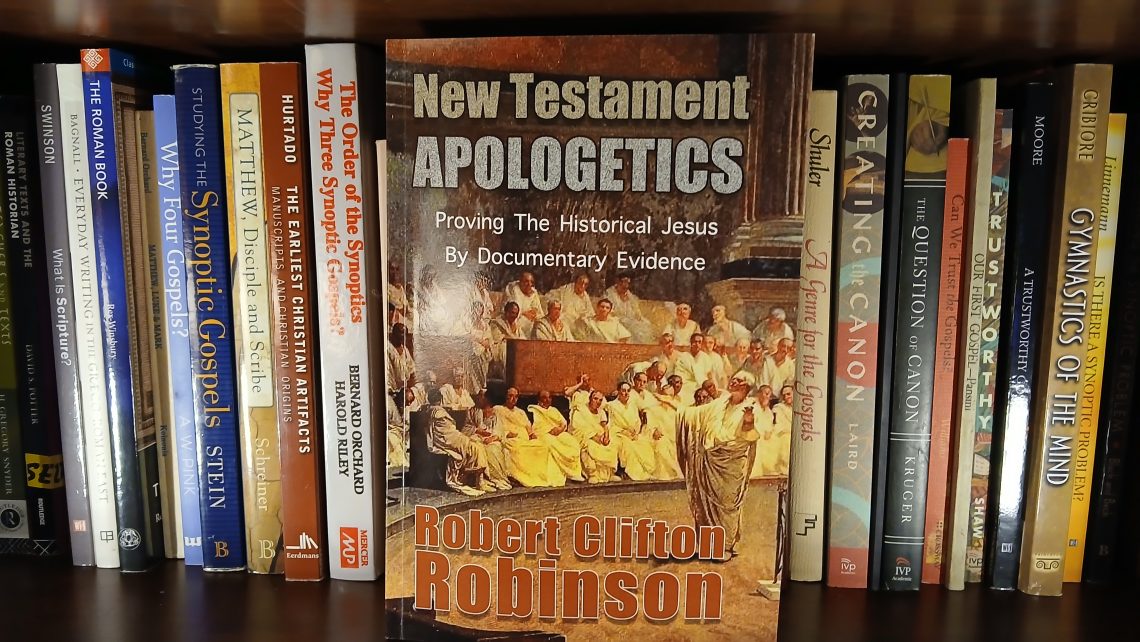
New Testament Apologetics: Proving the Historical Jesus by Documentary Evidence. By Robert Clifton Robinson. Phoenix, AZ: Teach the Word Publishing, 2024, 592 pages.
This is a massive work and Robinson must be applauded for his efforts to defend the integrity of the NT, both in this book and on-line, where much of the book’s contents have also been posted. My immediate interest was limited to Robinson’s discussion of the dating and circumstances surrounding the publication of the Synoptic Gospels. This is mostly covered in chapter four but is also touched on elsewhere. Some aspects of the manuscript were helpful, yet there were also frustrations.
The Prompt Publication of Gospels
In the Preface and later, I appreciated his forthright assertion that “the men who saw and heard Jesus … immediately recorded the events we find in our modern NT, and they distributed these texts just as Jesus commanded—to “the ends of the earth” (p. xxv). Similarly:
Does anyone really think that Jesus came into the world to die for all sins, perform over 40 miracles that had never been seen on earth before, be crucified in paying for the sins of the world, and raised from the dead, only to call illiterate men who were incapable of recording what they saw? (p. xxv).1
Later, Robinson adds:
In John 9:4, Jesus told the disciples, “We must quickly carry out the tasks assigned to us by the one who sent us.” Jesus did not want these men to delay their witness to the world. Jesus intended that the men who saw and heard Him, would “quickly carry out the task” of telling the world what they had witnessed. They did this by writing on papyrus the things they had seen and heard and sending them out to the Christian churches that already existed in Asia Minor. These churches copied the letters of testimony written by the men who saw Jesus, and they distributed them all over the Roman Empire.
The reason Jesus emphasized the urgency of sending out a written testimony is clear: God wanted the whole world to know that salvation was available to everyone. God had kept His promise to send the world a Savior, and He desired that every person would have a chance to hear what Jesus had done and be saved. Jesus wanted the people who were alive at that time, in every distant land of the world, to also have the opportunity to receive Jesus and obtain salvation. The idea that the Gospels would not be written for decades, or that Jesus did not intend that the Apostles would write a testimony about Him and send it to the world, is preposterous (p. 62–63).
While Robinson’s translation of John 9:4 is unfamiliar, the point is valid, that the apostles were obligated to promptly communicate the Gospel to the world. With regard to the Great Commission, Joel Grassi has similarly argued: “In fact, it is scripturally sound and theologically reasonable to conclude that Matthew was writing Matthew during the events recorded in Matthew and that he published it as soon as possible in obedience to the Great Commission.”2
Later, Robinson aptly picks up this theme again. These are the kinds of arguments that I most appreciated.
The evidence that the Gospels were written immediately after Jesus rose from the dead is found in the text itself where Jesus makes this requirement an imperative. There is absolutely no evidence anywhere that these men waited for decades to write their testimony. The only source for this late-date idea comes from liberal scholars, who have an agenda to try and rob the Gospels of their eyewitness testimony.3
How could any scholar know the precise decade when the Gospels were written? Those who guess say later; those who read Jesus’ words see that He said: “What you see, write in a book and send it now…” The two Gr. imperatives “write” (γράφω) and “send” (πέμπω) are peremptory, authoritative aorists. “Do It Now!”
Until it can be proven, by evidence, that the Gospels actually were written late in the first century, I will maintain an early date for their writing. There is no proof they were written late; there is tremendous internal proof within the New Testament that the Gospels were immediately written (p. 86).
Robinson also reasonably argues that Paul needed a written Gospel for his missionary campaigns in order “to prove that the Gospel of Christ was authentic and reliable,” since Paul was not a witness to the events and teaching of Jesus. (p. 69). With Robinson (p. 69), I have also argued that Paul used the Gospels when in the synagogues, examining the Scriptures. Yet, I suggest that Robinson goes too far when claiming that references to the “word of God” in passages such as 1 Thessalonians 2:13 definitively refer to published Gospels (p. 69), as the phrase often refers to that which has been spoken (e.g., Acts 4:31).
Gospel Publication Dates
Robinson identifies dates for several of the events in Acts—the famine of Acts 11:27–28 is in 46–47 AD, Paul is on trial before Festus in 58–59 AD, the arrival of Paul in Rome per Acts 28:1–16 in 60 AD, etc. (p. 63–66). Based on the ability to date events in Acts, and knowing that the Gospel of Luke was written before Acts, Robinson jumps to the conclusion that Luke was written by 44 AD (p. 66).4 This is evidently on the questionable premise that the author of Acts could not have recorded (or observed?) events related to Paul’s ministry until after Luke was published. At the same time, no driving circumstance for the publication of Luke is offered, given that Matthew and Mark had recently been published. I tend to favor a later date for Luke, after an emergent need necessitated a new Gospel.
A handy timeline is provided which dates the resurrection at 32 AD, Matthew and Mark at 33 to 43 AD, Luke at 44 AD, initial work on Acts at 46 AD, etc. (p. 75). These dates for Matthew and Mark are not far from what I affirm; however, Robinson does not explain how he got to the date for Mark in this chapter, other than assuming that it was before Luke. And then later, when arguing that the Gospel of Mark was not anonymous, a different date is given: “The Gospel of Mark was probably one of the first books written in the New Testament, likely near 55–59 AD” (p. 102). — This sentence is also on Robinson’s website.5I hope that in response to this review, Robinson will update the website to convey the desired date.
A Couple Other Thoughts, as I Jumped Around
In chapter five, Robinson addresses whether the Gospels were anonymous and what this meant to their reliability. I found this observation to be insightful:
John tells us why he didn’t put his name on the Gospel he wrote:
John 7:18 “Those who speak for themselves want glory only for themselves, but a person who seeks to honor the one who sent him speaks truth, not lies.”
John had heard Jesus say this, and it had a profound effect on his decision to not place his name at the beginning of his testimony about Jesus. Only an honest and truthful person writes a testimony about someone and leaves their name off of the documents. … they were seeking to glorify Jesus … The fact that these four Gospels do not specifically indicate the name of the writer, yet they leave us clues to their identity throughout the text, is certain evidence they wrote a truthful narrative with honest intentions (p. 90).
In chapter thirteen, Robinson surveys the writings of the church fathers—Papias, Irenaeus, Justin Martyr, Clement, etc. He taps their testimony in support of a couple of his arguments, but fails to address their conflicting testimony, and those statements that potentially go against the early dates. This cherry-picking is a failure that I see in both apologists and critics—and is what led me to propose some novel solutions in A Trustworthy Gospel. Also, Robinson asserts, based on his reading of Papias’ testimony that “Peter dictated the words of Mark’s Gospel” (p. 283). It is unclear how this meaning is extracted from his quote of Papias.
In Summary
In summary, for the material that I surveyed, I appreciated the arguments for the prompt publication of Gospels and the insight into why the Gospel authors might have refrained from identifying themselves. At the same time, there were some arguments that were overstated. I do look forward to one day reading through the many chapters on other apologetic topics.
I always appreciate other voices who are trying to work through the Synoptic problem, while unashamedly expecting the apostles and their team to publish early for the benefit of the growing Christian community. For that reason, I encourage others to read the book, although with a critical eye, recognizing that some arguments warrant further reflection. Robinson’s website also has a wealth of content, including large excerpts from the book.
- This statement is also found in https://robertcliftonrobinson.com/2024/03/14/new-testament-apologetics-now-available-in-paperback. ↩︎
- Joel Grassi. https://commonwealthbronx.org/wp-content/uploads/2025/07/A-Trustworthy-Gospel-Review-1.pdf ↩︎
- This denunciation against certain scholars can be found repeated throughout the book. Some of this sentiment can also be heard in Phil Fernandes, “Redating the Gospels,” in Vital Issues in the Inerrancy Debate, ed. F. David Farnell (Wipf and Stock, 2015). ↩︎
- In the book, Robinson actually claims that “both Acts and Luke’s Gospel were written by 44 AD,” which is obviously an unintentional error, since this line is correct online to only refer to Luke. https://robertcliftonrobinson.com/when-were-the-gospels-written/ ↩︎
- https://robertcliftonrobinson.com/2018/02/11/the-four-gospels-were-not-written-anonymously/ ↩︎
NOTE: Comments and dialog are welcome. The “Leave a Reply” field will be accessible below for 10 days after this post was published. Afterwards, please feel free to continue to comment via the contact page. (This is my attempt to manage the spam bots.)