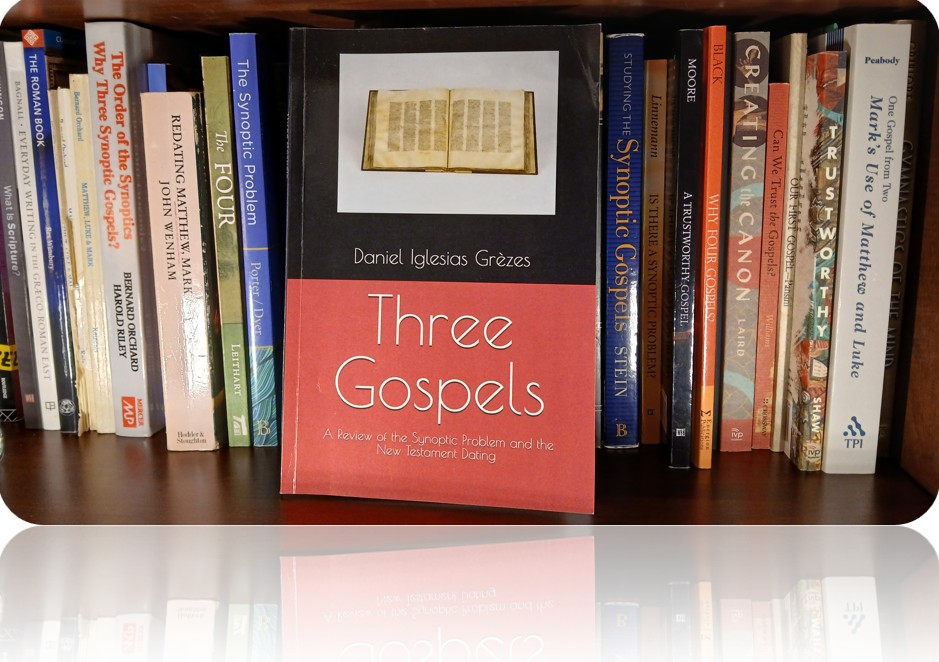
Daniel Iglesias Grèzes, Three Gospels: A Review of the Synoptic Problem and the New Testament Dating, first English edition (Montevideo, UY, 2025).
Adding to the list of those who argue for an early Matthew, Daniel Iglesias Grèzes has recently translated into English his assessment of the Synoptic problem, previously published in Spanish. Despite the approach of many critical scholars who maintain that the gospels “were written after 70 AD,” subsequent to the Jewish War, with “Mark around 70 AD,” followed by “Matthew and Luke around 80–90 AD” (10), Iglesias instead largely aligns with John Wenham’s Redating Matthew, Mark, and Luke1 in contending (1) that Luke was published before the mid-50s, given the reference to the “brother whose fame in the gospel is throughout the churches” (2 Cor. 8:18, citing Wenham’s translation)2 (128–129); (2) that Mark was published before Luke, around 45 AD, as one of the previously published accounts of the life of Jesus referenced in Luke 1:1 and following an early trip to the Roman capital by Peter and Mark (131–132); and (3) that Matthew was published before 42 AD, consistent with the testimony of the church fathers that Matthew was the first Gospel and supposing an early trip by Peter to the capital as the “another place” referenced in Acts 12:17 (131–133).
While Iglesias covers much of the same introductory material as other works on the Synoptic problem, he also adds extra engagement with Catholic perspectives and sources; for example, surveying documents of the Pontifical Biblical Commission (1911) and the “subsequent evolution of Catholic theology,” including documents published as part of the Second Vatican Council (53–56). He also engages with the contributions of Catholic scholars such as Jean Carmignac, Claude Tresmontant, José O’Callaghan, Bernard Orchard, Dennis Barton, Raymond Brown, and, most recently, Jonathan Bernier. Ultimately, he directs an appeal to “the Magisterium of the Church to officially reaffirm Matthean priority,” per the earlier PBC position, while “perhaps leaving open to expert discussion the issue of the order of composition of the remaining three Gospels, or at least the question of whether the Gospel of Mark was the second (after Matthew) or the third (after Matthew and Luke)” (56–57). This open question is with deference to Bernard Orchard’s proposed “Two Gospel hypothesis (i.e., the Clementine hypothesis),” which proposed a Matthew-Luke-Mark publication order (56).
Iglesias accepts the testimony of the prologue of Luke that others had previously written accounts of the life of Christ (31). However, he quickly discounts the possibility that one of these accounts might have been the Q document hypothesized by many Markan prioritists, not only because the hypothesized Q was not a narrative as described by Luke 1:1, but also because “it seems unlikely that the early Christians would have allowed one of the early gospels to be completely lost without leaving any papyrological, archaeological, or literary trace” (32). Additionally, Iglesias also quickly dismisses even a Markan priority approach without Q given the “early testimonies regarding Matthean priority,” as asserted by “Irenaeus of Lyons, Clement of Alexandria, Origin, and Augustine of Hippo” (37). Addressing one debated issue, Iglesias accepts his perceived reading of the church fathers that Matthew first wrote in Hebrew (39–41). He then turns to Carsten Thiede’s (highly contested) claims concerning the dates of several papyrus fragments to postulate that our Greek Matthew was written around 45 AD (43).3 With respect to the Matthew-Luke-Mark publication order theorized by Orchard and others, Iglesias discounts Orchard’s proposals as “ingenious,” but “probably too complex and based in part on risky speculation” (85–87). Correspondingly, Iglesias discounts Orchard’s leveraging of Clement of Alexandria’s testimony concerning the order of the Gospels; instead, echoing Wenham’s approach to interpreting Clement (90–91).4
The book then goes on to consider and largely affirm Wenham’s adoption of the Augustinian hypothesis, with its Matthew-Mark-Luke publication order, followed by discussions on the dates of the other NT books. Central to Wenham’s scenario of Gospel publications is an early trip to the Roman capital, supposedly alluded to in Acts 12:17, as indicated above. It is at this point that I need to interject an objection, as it is difficult to entertain a proposal that Acts 12:17 opaquely refers to an early trip to Rome (131–132). While we must recognize that Acts does not offer a comprehensive account of the early decades of the church, nonetheless, if one accepts that Acts was completed in 62 AD as Paul sat in a Roman prison, then I find it inconceivable that Luke—while writing Acts 12 with its parallel story of a Petrine imprisonment and miraculous release—would choose to forget the parallel story of Peter and Mark’s travels to Rome two decades earlier. Admittedly, the purpose of Acts is debated, but under what scenario would it make sense for Luke to intentionally neglect to mention such a significant event of bringing the gospel to the Roman capital after God had miraculously freed an apostle? Furthermore, Wenham’s attempt to discount Irenaeus’ testimony5 that Paul was an active participant in the founding of the church in Rome, alongside Peter, at the time when Matthew was written, by claiming that “Irenaeus is often misinterpreted,” is unconvincing (133).6 Wenham claims that “Irenaeus is answering the question, ‘How has this preaching come down to us in writing'” and that “dating is foreign to the argument; [hence,] there would be no motive for pointing out a synchronism between the writing of Matthew and the preaching of Peter and Paul,” etc.7 My counter is that there is indeed a potential motive, if Irenaeus’ assertion (as traditionally understood) is giving us rough dates for the Gospels with the intent of substantiating the antiquity and authority of such, against the crazy inventions of the Valentinians, who are the antagonists of this portion of Irenaeus’ five-volume tome. While I affirm the dating argued by Wenham and Iglesias, I simply find the proposed scenario to be too speculative.8
My limited objections aside, I found Three Gospels to be a well-written book and more readable than Wenham’s volume. Wenham was staking out a position that had not been seriously defended since John Chapman’s volume half a century earlier, with Chapman’s work being posthumously compiled and published; and unfortunately, inadequately advocated by his successors.9 Furthermore, by necessity, both Chapman and Wenham substantively waded into comparisons of the Greek text of the Gospels in order to demonstrate the legitimacy of their claims against similar comparisons performed by those arguing for other Synoptic theories. Without the need to again perform these comparative forays, Iglesias has been able to effectively leverage the earlier works, while also engaging with other voices—for example, challenging Bernier’s willingness to adopt Markan priority (118), exploring Carmignac’s view of the original language of the Gospels (103–109), and recounting Carmignac’s assessment of passages in 2 Corinthians 3 that might suggest that Paul was already thinking in terms of a collection of new covenant books, which might also suggest the existence of “at least one Gospel” (128–129).
All in all, a hearty recommendation for Three Gospels: A Review of the Synoptic Problem and the New Testament Dating.
Happily, Three Gospels is not only available in print form, but is also available for free download at https://danieliglesiasgrezes.wordpress.com/wp-content/uploads/2025/12/dig-tres_evangelios-english.pdf
(download at your own risk!)
- John Wenham, Redating Matthew, Mark & Luke: A Fresh Assault on the Synoptic Problem (Sevenoaks, Kent: Hodder and Stoughton, 1991). ↩︎
- Wenham, Redating, 223. ↩︎
- Carsten Peter Thiede and Matthew D’Ancona, Eyewitness to Jesus: Amazing New Manuscript Evidence about the Origin of the Gospels (New York, NY: Doubleday, 1996). ↩︎
- Wenham, Redating, 183. ↩︎
- Irenaeus, Haer. 3.1.1. ↩︎
- Wenham, Redating, 223, 240–41. ↩︎
- Wenham, Redating, 223, 240–41. ↩︎
- Of course, this is when I now suggest that readers consult my A Trustworthy Gospel for a preferred solution. Daniel B. Moore, A Trustworthy Gospel: Arguments for an Early Date for Matthew’s Gospel (Eugene, OR: Wipf and Stock, 2024). ↩︎
- John Chapman, Matthew, Mark and Luke: A Study in the Order and Interrelation of the Synoptic Gospels, ed. John M. T. Barton (London: Longmans, Green, and Company, 1937). ↩︎
NOTE: Comments and dialog are welcome. The “Leave a Reply” field will be accessible below for 10 days after this post was published. Afterwards, please feel free to continue to comment via the contact page. (This is my attempt to manage the spam bots.)