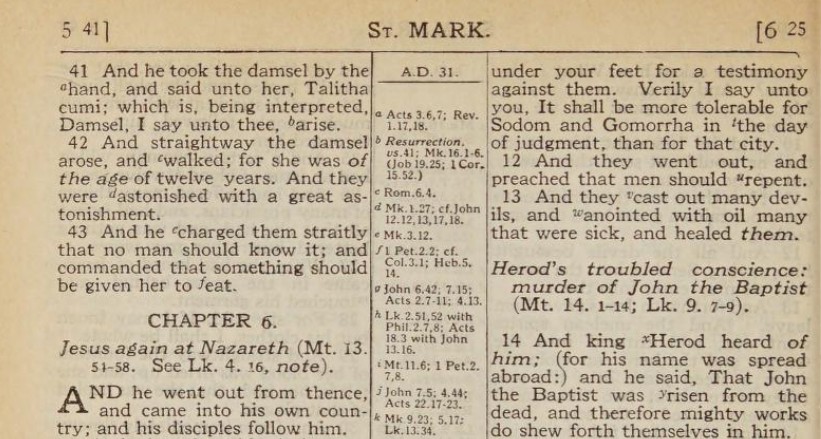
The Gospel of Mark offers Greek translations for a variety of Aramaic words. What does this tell us about Mark's intended audience? Many scholars claim that Mark's translations demonstrate that his audience was not familiar with Aramaic. However, if we look closely at how both Mark and Matthew handle the…
-
-
In this article, we explore yet another instance where assumptions concerning the publication dates of the Gospels impact one's understanding of the meaning of the Gospels. Here, the parable of the wicked tenants is said by several scholars to be properly understood as teaching that the "others" who would assume…
-
If Paul had actually meant to refer to his verbal presentation before the Galatians—of Christ crucified—as commentaries often contend, then would he have indeed used proegraphē, which nominally means previously written? This article explores ways he could have expressed "publicly portrayed," if that was his intent.
-
Matthean priority and an early Matthew are argued in this podcast from Truth in My Days.
-
This article challenges the assertion by some scholars that Mark’s use of transliterated Latin words helps to demonstrate a Greco-Roman audience.
-
Stevens dates Matthew as being published in AD 31–38 and Mark as AD 38–44. Again, this is on the premise that the resurrection was in AD 30. Stevens notes the parallels between Matthew 24 (the Olivet Discourse) and Paul's letters to the Thessalonians as a basis for arguing that Matthew…
-
In Against Heresies 3.1.1, Irenaeus correlates Matthew's publication with when Peter and Paul began preaching in Rome, which I argue refers to Rome, the empire. This article reviews a similar usage of Rome, as the empire, found in 1 Maccabees 8.
-
Leithart addresses three questions which arise because of the similarities and differences between Matthew, Mark, and Luke: "Where do the Gospels come from? Which Gospel comes first? Do any of the evangelists [Gospel authors] use the writings of other evangelists?"
-
The most popular modern hypothesis for explaining the publication order of the Synoptic Gospel is that Mark was published first, followed by Matthew and Luke, each having used Mark and other sources without having consulted each other. Variations exist on this hypothesis; but consistently, Mark is claimed to have been…
-
In 1792, John Eveleigh delivered the annual Bampton Lectures at Oxford. At the time, Eveleigh was the provost of Oriel College, one of the colleges of Oxford, and prebendary of Rochester Cathedral. The lectures were published under the title: A View of Our Religion: With Regard to its Substance, With…