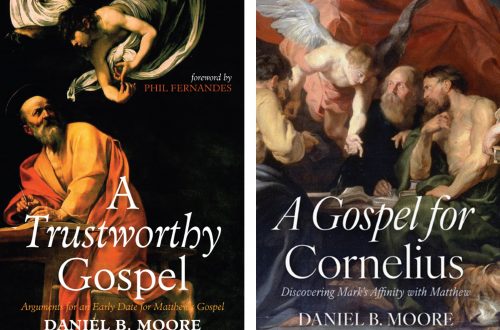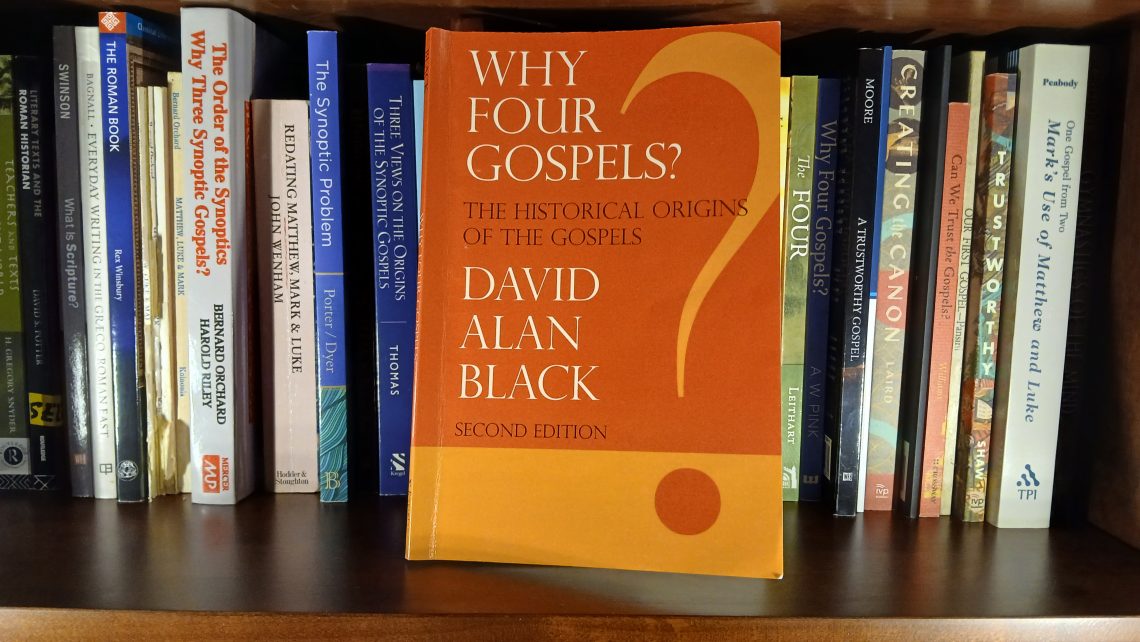
David Alan Black’s Why Four Gospels? provides an attractive framework for situating the publication of the four Gospels per his Fourfold Gospel Hypothesis. Perhaps most appealing is Black’s affirmation that Matthew was published in support of the teaching, administrative, and apologetic needs of the early church, in Greek, and within “the first decade of the church’s life, that is before AD 44, and thus . . . before 1–2 Thessalonians and Galatians.”1 Elsewhere in the book he refines this to locate Matthew as being published between AD 30 and 42.2 I appreciate this perspective, as Black (1) recognizes that Matthew was written at a time when the church was predominantly Jewish, (2) recognizes the affinity that Jewish Christians had with written Scriptures, (3) leverages the writings of the church fathers, and (4) otherwise rejects the popular proposition that early Christians waited for decades before publishing the life and teachings of Jesus.3 These are perspectives that I advocate in A Trustworthy Gospel. Yet, Black’s Fourfold Gospel Hypothesis follows Bernard Orchard in contending that the publication of Matthew was followed by Luke, and then by Mark and John.4 Since this differs from the Matthew-Mark-Luke-John publication sequence that I have been advocating, I would like to offer an alternative approach.
In summary, Black visualizes the development of the Gospels as proceeding in four stages, or phases:
- “The Jerusalem Phase (AD 30–42; Acts 1–12),” during which Matthew was published.
- “The Gentile Mission Phase (AD 42–62; Acts 13–28),” during which Luke was written, but not published.
- “The Roman Mission Phase (AD 62–67; Acts 13–28),” during which Luke was published in AD 62, and Mark in AD 66–67.
- “The Johannine Supplement,” during which John was published in AD 95.5
Central to Black’s proposition concerning the publication of Mark and Luke is his understanding that Clement of Alexandria makes the claim that Mark was published after Luke, an understanding that I have challenged in Gospel Publication Sequence per Clement of Alexandria.6 Furthermore, Black contends that the publication of Luke was withheld until Mark was drafted in the Roman capital as a record of Peter’s discourses—discourses in which Peter leveraged both Matthew and Luke, thereby providing apostolic and eyewitness sanction to Luke’s Gospel and leading to the subsequent publication of both Luke and Mark in Rome.7
In contrast, I have countered that when Clement, Irenaeus, and subsequent church fathers spoke of Gospels as being published in Rome, they should be understood as referring to the Roman empire, not the Roman capital. Accordingly, the church fathers may be understood as reporting that Matthew was published as Peter and Paul first began preaching to non-Jews outside of predominantly Jewish regions, coincident with the events of Acts 10–11, and that Mark was published shortly thereafter.8 Note that Black does not similarly attempt to reconcile the testimony of the church fathers concerning the circumstances of the publication of Matthew, other than to accept their testimony that Matthew was first.
Appropriately, Black recognizes the significance of the Christian persecutions under Herod Agrippa I, as recorded in Acts 12, during which time James was killed and Peter imprisoned.9 The temporary restoration of Herodian rule over Judea (AD 41–44) under Agrippa I was a difficult time for Christians, as Herod sought to please the Jews (Acts 12:3), perhaps motivated by a desire to pacify the unrest following Caligula’s inflammatory demands for worship.10 Prior to Herod, the Roman Prefect Marullus (ruled AD 37–41) was responsible for overseeing Judea, and we may speculate that it was during Marullus’ reign that Cornelius and his companions responded to the message preached by Peter in Caesarea Maritima, per Acts 10.11 Given this background, I offer the following alternative to Black’s multi-stage framework for the development of the Gospels.
The Progressive Proclamation and Publication of the Gospel(s)
- Gospel Proclamation primarily to the Jews (AD 30–40; Acts 1–11), but culminating with Gentile conversions in Caesarea Maritima and Antioch, and the publication of Matthew for Jewish Christians.
- Gospel Proclamation under Herod Agrippa I (AD 41–44; Acts 12), including the publication of Mark for Greco-Roman converts in Caesarea Maritima.
- Gospel Proclamation to the broader Greco-Roman world (AD 45–59; Acts 13–27), during which Luke is published in the early 50s for sophisticated Greco-Roman audiences in Ephesus, Macedonia, Athens, and Corinth.12
- Gospel Proclamation in Rome (AD 60–62; Acts 28), during which Acts is published in AD 62.
(At this time I am going to forego settling on a date for John’s Gospel; although, I presently lean towards a date before the Jewish War.)
This approach not only affirms that Matthew was promptly published for the benefit of early Jewish Christians, consistent with Black’s helpful framework, but also affirms that Mark was promptly published for the benefit of the earliest Greco-Roman converts, while Luke subsequently provided a more expansive presentation of the life and teachings of Jesus, oriented towards a more sophisticated Greco-Roman audience, as the Pauline mission brought the gospel to Ephesus, Macedonia, Athens, and Corinth. This is unlike Black’s contention that Luke’s publication was deferred until the 60s and that Mark was not originally intended for publication. Rather, the above paradigm contends that specific audiences were intended for each Gospel.
- David Alan Black, Why Four Gospels?: The Historical Origins of the Gospels, 2nd ed. (Gonzalez, FL: Energion, 2010), 4–5, 50, 53. ↩︎
- Ibid., 7, 73. ↩︎
- Ibid., 50–52. ↩︎
- Ibid., vi–vii. ↩︎
- Ibid., 3–19, 73–74. ↩︎
- Ibid., 27, 29, 31. ↩︎
- Ibid., 59–61. ↩︎
- For elaboration on this claimed inference, see Irenaeus’ “at Rome” affirms an early Matthew!, Irenaeus affirms an early Matthew: Rome means Roman Empire in 1 Maccabees 8 also; Daniel B. Moore, A Trustworthy Gospel: Arguments for an Early Date for Matthew’s Gospel (Eugene, OR: Wipf and Stock, 2024), 21–22, 34; A Caesarean Provenance for Mark ↩︎
- Black, Why Four Gospels?, 73. ↩︎
- Dates per Brian M. Rapske, “Roman Governors of Palestine,” in Dictionary of New Testament Background, ed. Craig A. Evans and Stanley E. Porter (InterVarsity, 2000), 978–84. ↩︎
- Few commentaries aspire to locate Cornelius’ conversion within the succession of Roman rulers. However, Keener appears to concur with the view that the conversion occurred before Agrippa’s rule. Craig S. Keener, Acts: 3:1 – 14:28, vol. 2, Acts: An Exegetical Commentary (Grand Rapids, MI: Baker Academic, 2012), 1735. ↩︎
- I find the argument to be reasonable that the reference in 2 Corinthians 8:18 (AD 56), to “the brother who is famous among all the churches for his preaching [rather, “in the things”] of the gospel,” reasonably refers to Luke and his Gospel, as argued by Wenham. John Wenham, Redating Matthew, Mark & Luke: A Fresh Assault on the Synoptic Problem (Sevenoaks, Kent: Hodder and Stoughton, 1991), 186, 230–37. ↩︎
NOTE: Comments and dialog are welcome. The “Leave a Reply” field will be accessible below for 10 days after this post was published. Afterwards, please feel free to continue to comment via the contact page. (This is my attempt to manage the spam bots.)