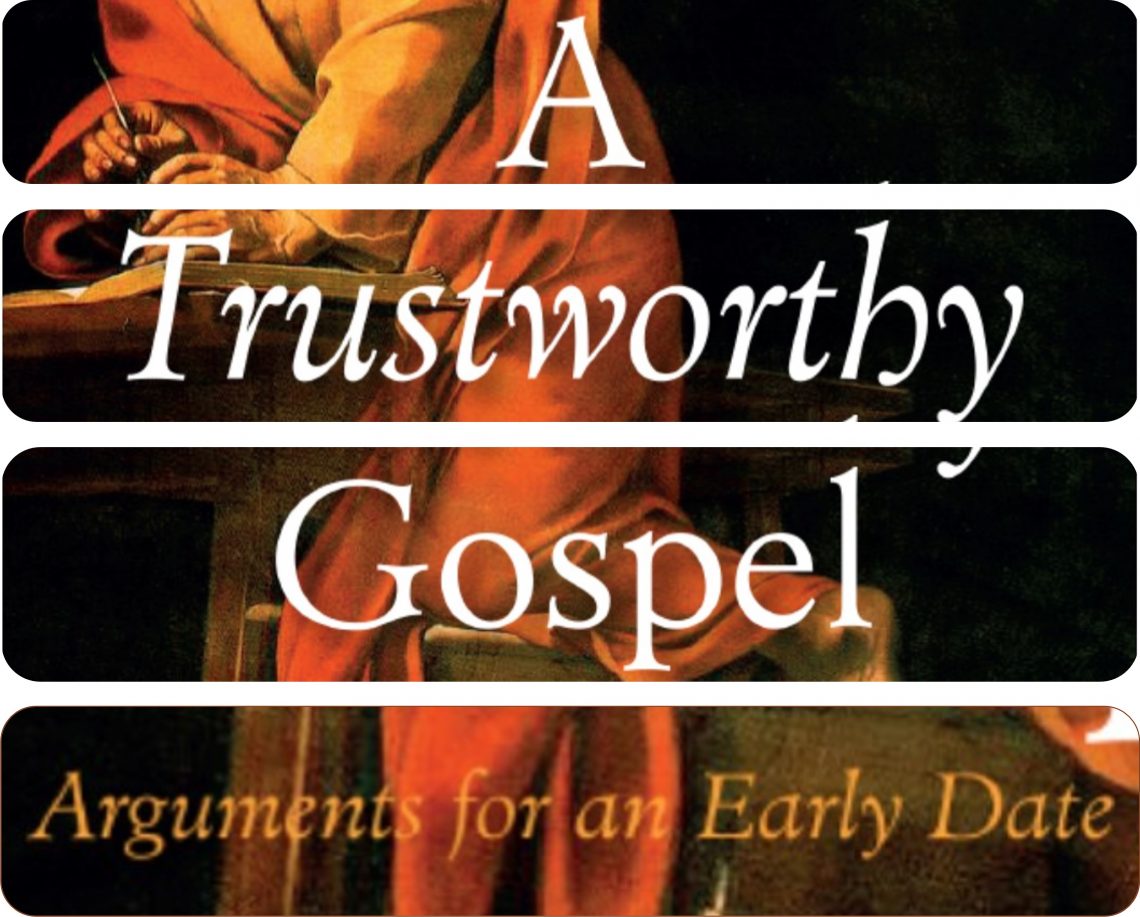
A favorable Amazon review of A Trustworthy Gospel was posted by Cory Marsh a couple months ago:
This book doesn’t merely argue for Matthean priority, but for a very early publication of Matthew—preceding all of Paul’s letters (several years [not decades] after Jesus’s ascension). The argument is especially reasonable when one considers that all of Paul’s letters presuppose the life and miracles of Jesus.
In making his case, Moore offers several compelling challenges to scholarly assumptions. The most important one may be his push against “oral tradition” taking priority for the first several decades of the Church (a tool not as valued as written materials with Greco-Roman audiences). Could the rapid early growth of Christianity be explained by simply oral tradition? Here I’m reminded of the Latin proverb: Verba volant, Scripta manent (“spoken words fly away, written words remain”).
The book also offers a better exegetical argument for translating “publicly portrayed” in Gal 3:1 as “previously written,” suggesting that Paul was referring to Matthew or a similarly published account of Jesus. A strong lexical, literary, and historical case is made with both canonical and non-canonical sources brought into the discussion.
Additionally, the book challenges Bauckham’s noteworthy theory on virtually perfect eyewitness memory decades after the fact. Instead, Moore argues that John 14:26 (the promise of the HS to bring remembrance to the disciples) was not a promise fulfilled decades later to aging disciples but to them immediately after Jesus’s ascension (connecting all the “then they remembered” texts in John). As Moore suggests, aging memory wouldn’t have been as reliable or accepted by Gentile audiences.
Finally, the book makes a compelling case for the disciple Matthew being Jesus’s “royal chronicler.” Like an OT scribe who wrote notes etc., Matthew chronicled Jesus ministry just as Jesus intended and commissioned him to do.
While several of Moore’s arguments are, by necessity, inferential or suggestive, so are many of the Gospel origin theories the scholarly community simply accepts. The book is well written and thought out, with a very engaging style. As a counter balance to several standard assumptions (e.g, priority for oral tradition), Moore offers a refreshingly compelling and bold contribution that deserves serious consideration.
Thanks!