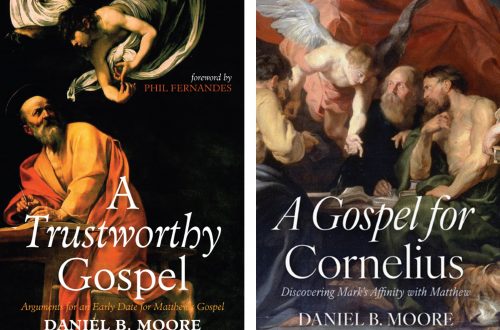
My upcoming book on Mark’s Gospel explores exegetical insights and harmonization benefits that are available if one accepts the premise that Mark was published for the benefit of Cornelius and friends in Caesarea Maritima shortly after their conversion per Acts 10, and shortly after the publication of Matthew’s Gospel. This scenario flows out of several arguments developed in A Trustworthy Gospel: Arguments for an Early Date for Matthew’s Gospel, including the assertion that early followers of Jesus valued Christian literature and that church leaders were motivated to produce such, in accord with the need expressed in Matthew 28:18–20 and Timothy 3:16.1 One argument underlying the claim that Matthew was published within a decade of the resurrection was the proposition that whenever the church fathers referred to Rome, relative to the publication sequence of the Gospels, they had in view the Roman empire, rather than the imperial capital.2 If this is accepted, then Irenaeus’ testimony suggests that Matthew was published as Peter and Paul first began preaching within the broader Roman empire outside of predominantly Jewish regions (e.g., in Caesarea Maritima and Antioch, per Acts 10–11), and that Mark was published “after their departure” to continue preaching elsewhere within the empire (per Acts 12).3
In this article I offer my approach to harmonizing the testimony of Clement of Alexandria, which some scholars contend presents a competing Matthew-Luke-Mark publication sequence.4
Eusebius, in his sixth book of church history, reports that Clement stated that the Gospels with the genealogies were “first written,” before Mark and John:5
[5] And again in the same books Clement has inserted a tradition of the primitive elders with regard to the order of the Gospels, as follows. He said that those Gospels were first written which include the genealogies, [6] but that the Gospel according to Mark came into being in this manner: When Peter had publicly preached the word at Rome, and by the Spirit had proclaimed the Gospel, that those present, who were many, exhorted Mark, as one who had followed him for a long time and remembered what had been spoken, to make a record of what was said; and that he did this, and distributed the Gospel among those that asked him. [7] And that when the matter came to Peter’s knowledge he neither strongly forbade it nor urged it forward.6
Unfortunately, Clement’s original work no longer survives, as referenced by Eusebius; therefore, we lack the context for Clement’s statement, nor can we assess the correctness of Eusebius’ quote or paraphrase. Adding to the quandary is that Eusebius subsequently cites Origen as affirming a Matthew-Mark-Luke publication order.7 Carlson reminds us that Origen was “one of Clement’s pupils as well as his immediate successor of the catechetical school of Alexandria.”8 Furthermore, Origen “claimed that he [Origen] learned this sequence by tradition,” suggesting that his view was in alignment with what Clement actually taught.9 Amazingly, Eusebius offers all of these perspectives, while also affirming the Matthew-Mark-Luke publication sequence himself, without suggesting that a conflict exists with Clement, whom he had cited only moments earlier in a passage referring to the beloved disciple, John.10 Per Wenham, “this must suggest a strong possibility that Eusebius himself did not regard the sources he quotes as contradictory.”11
Watson suggests that Eusebius has preserved a passage from Clement, “but conflates it” by inserting “the anecdote about the origins of the Gospel of Mark.”12 Thus, Clement’s original concern was merely to draw a contrast between the previously written Gospels with genealogies, which begin by tracing the “bodily facts” of Jesus’ origin, and John’s subsequent Gospel, which begins by tracing “the origins of his earthly life back into the ‘spiritual’ sphere of the preexistent Logos.”13 Whether or not the Markan “anecdote” was original with Clement or was inserted by Eusebius, Watson’s insight is appealing, as it clarifies that Clement’s interest in this passage was not to make a claim regarding the relative sequence of Mark, nor even of Matthew and Luke, relative to each other. Rather, Clement’s exclusive interest was in contrasting the publication of the two Gospels with genealogies with the publication date of John. From this perspective, the reference to Mark is simply added for completeness, without necessarily asserting that Mark was published after Matthew and Luke (or Luke and Matthew!).
- Daniel B. Moore, A Trustworthy Gospel: Arguments for an Early Date for Matthew’s Gospel (Wipf and Stock, 2024).
Also see On the Premise of Matthean Priority, Which Gospel Came Next? ↩︎ - Moore, A Trustworthy Gospel, 19–30. Also, Irenaeus’ “at Rome” affirms an early Matthew!; Irenaeus affirms an early Matthew: Rome means Roman Empire in 1 Maccabees 8 also. ↩︎
- Irenaeus, Haer. 3.1.1. ↩︎
- For example, William R. Farmer, The Synoptic Problem: A Critical Analysis (MacMillan, 1964), 1–2, 8, 282; Bernard Orchard and Harold Riley, The Order of the Synoptics: Why Three Synoptic Gospels? (Mercer University Press, 1987), 163–64; David B. Peabody et al., eds., One Gospel from Two: Mark’s Use of Matthew and Luke (Trinity Press International, 2002), 49–50; David Alan Black, Why Four Gospels?: The Historical Origins of the Gospels, 2nd ed. (Energion, 2010), 76. ↩︎
- Eusebius, Hist. eccl. 6.14.5–7. ↩︎
- Eusebius, Hist. eccl. 6.14.5–7; Eusebius, The Ecclesiastical History, vol. 2, trans. Kirsopp Lake et al., Loeb Classical Library (William Heinemann Ltd, 1932), 49. ↩︎
- Eusebius, Hist. eccl. 6.25.4–6. ↩︎
- Stephen C. Carlson, “Clement of Alexandria on the ‘Order’ of the Gospels,” New Testament Studies (Cambridge, UK) 47, no. 1 (2001), 120. ↩︎
- Ibid. ↩︎
- Eusebius, Hist. eccl. 3.23.1–8; 3.24.6–7. ↩︎
- John Wenham, Redating Matthew, Mark & Luke: A Fresh Assault on the Synoptic Problem (Hodder and Stoughton, 1991), 192. ↩︎
- Watson credits Helmet Merkel with this proposal. Francis Watson, Gospel Writing: A Canonical Perspective (Eerdmans, 2013), 432, 432n84; Helmut Merkel, “Clemens Alexandrinus Über Die Reihenfolge Der Evangelien,” Ephemerides Theologicae Lovanienses 60 (1980), 382–85. ↩︎
- Watson, Gospel Writing, 433–34. ↩︎
NOTE: Comments and dialog are welcome. The “Leave a Reply” field will be accessible below for 10 days after this post was published. Afterwards, please feel free to continue to comment via the contact page. (This is my attempt to manage the spam bots.)